This Amateur Radio DX news, Solar Flare info and Contest information is provided by: RAC, dxnews.com, 424 DX News, spaceweatherlive.com and contestcalendar.com
On this page you will find a collection of links from the above sites.
Don’t forget the RAC WINTER CONTEST this weekend:
RAC Canada Winter Contest Rules 2025: https://www.rac.ca/rac-canada-winter-contest-rules-2025/
Bands and Modes: 160, 80, 40, 20, 15, 10, 6 and 2 metres, CW and phone (SSB, FM, AM, etc.)
Suggested frequencies: CW – 25 kHz up from the band edge and for SSB – 1850, 3775, 7060*, 7225, 14175, 21250 and 28500 kHz. Check for CW activity on the half-hour.
*Note: For 7060 kHz please watch for conflicts in the band plan where there are overlaps with other modes of operation.
Exchange: Stations in Canada send RS (T) and province or territory. VEØs and stations outside Canada send RS (T) and a serial number.
QSOs: Contacts with stations in Canada or VEØs (maritime mobile Canadian stations) are worth 10 points. Contacts with stations outside Canada are worth 2 points. Contacts with RAC official stations are worth 20 points. RAC official stations are: VA2RAC, VA3RAC, VE1RAC, VE3RHQ, VE4RAC, VE5RAC, VE6RAC, VE7RAC, VE8RAC, VE9RAC, VO1RAC, VO2RAC, VY0RAC, VY1RAC and VY2RAC.
You may work any station once on each of the two modes, on each of the eight contest bands. It is prohibited to make CW contacts in the conventional phone sub-bands and phone contacts in the conventional CW sub-bands. Contacts or soliciting QSOs through a repeater during the contest period is not allowed. Contacts in the RAC Canada Contests also count towards the RAC Canadian Portable Operations Challenge Award.
Multipliers: Thirteen in total, Canada’s 10 provinces and three territories. Each multiplier may be counted once on each mode on each of the eight contest bands.
The multipliers, with their postal abbreviations and prefixes are: Nova Scotia [NS] (VE1, VA1, CY9, CYØ); Quebec [QC] (VE2, VA2); Ontario [ON] (VE3, VA3); Manitoba [MB] (VE4, VA4); Saskatchewan [SK] (VE5, VA5); Alberta [AB] (VE6, VA6); British Columbia [BC] (VE7, VA7); Northwest Territories [NT] (VE8); New Brunswick [NB] (VE9); Newfoundland and Labrador [NL] (VO1, VO2); Nunavut [NU] (VYØ); Yukon [YT] (VY1); and Prince Edward Island [PE] (VY2).
Certain special Canadian prefixes in use at the time of the contest may also apply; however, there may be no more than 13 multipliers on each band/mode. Please use the multiplier abbreviations, in square brackets, noted above.
Note: in the event a station is unable to make a contact with a Canadian station, there will be granted a multiplier count of 1 to facilitate the proper calculation of the final score since a multiplier of zero (0) would not create a valid calculation of a final score.
Final Score: The total sum of QSO points (2, 10 and 20-point QSOs) from all bands multiplied by the total number of multipliers from all bands. Table 1 in the PDF document in the left column provides an example score calculation.
Take note that 12, 18 and 30 Meters are not used in contests!
WA7BNM Contest Calendar to Dec. 11:
To see other Contest information for the next 8 Days of Contests go to: https://www.contestcalendar.com/weeklycont.php
This week let us check commonly used lingo or words and “Q” codes used in DXing** and Contesting.
DX**: Refers to a long-distance contact or a rare station.
CQ: A general call to any station for a contact (QSO).
Work: To successfully make contact with another station.
Simplex – Single Frequency, without a repeater acting as a middleman
Split – transmitting on one frequency while receiving on another, typically used by rare DX stations to manage huge “pileups” (many callers).
Pileups – many stations calling at same time.
CW: Continuous Wave, which typically refers to Morse Code operation.
Rag chew: A long, informal conversation.
Rig: The amateur radio equipment/transceiver.
UTC: Universal Time Coordinate – Also known as Greenwich Mean Time (GMT); Coordinated Universal Time; Zulu time (Z). NOTE: Always use UTC time! UTC time is 4 hours ahead of our local time in winter and 3 hours ahead in summer. Example: Local being 7:00AM Local the time would be 11:00AM UTC, 12:00PM “Noon” would be 16:00 UTC or Zulu. Also use the 24-hour clock (military time) format. Example: 15:00 is 3:00 PM, 14:00 is 2 PM, 18:00 is 6 PM and 21:00 is 9 PM.
73: Best regards. Use just 73 not 73s.
88: Best regards to a XYL or YL
Q-Codes (Standardized Abbreviations)
The Q-code was originally developed for commercial radio-telegraph communication but is widely used by hams for both Morse code and voice.
QRZ: When a station finishes a contact and is ready for the next one, essentially asking “Who’s next?” or “I’m ready for calls!” , Who is calling me” , “You are being called by…
QSL: I acknowledge or confirm receipt of contact (often a physical postcard sent to confirm a contact).
QSO: A conversation or contact.
QSY: Change frequency.
QTH: Location (e.g., “What is your QTH?” or “My QTH is Kensington”).
QRP: Low power operation.
See the complete list of printable “Q” codes and Phonetic Alphabet here: https://www.arrl.org/files/file/Get%20on%20the%20Air/Comm%20w%20Other%20Hams-Q%20Signals.pdf
SOLAR Information:
Take note of Solar Flares and activity which can be found on the left side of this site under “Band Conditions”, they are a huge part of successful DXing on HF!
OKAY…but what does the info and numbers in that side bar mean?
The three main items you want to pay attention to are the SFI (Solar Flux Index), the K-Index and the A-Index. You may want to print the following for future reference.
SFI – Summarization of the Sun’s Radiation Output
70 – Not Good
80 – Good
90 – Better
100+ – Best
A-Index – Daily Average of Magnetic Activity
A = 0 – 7 Quiet
A = 8 – 15 Unsettled
A = 16 – 29 Active
A = 30 – 49 Minor storm
A = 50 – 99 Major storm
A = 100 – 400 Severe storm
K-Index is updated every 3 Hours
K = 0 Inactive
K = 1 Very quiet
K = 2 Quiet
K = 3 Unsettled
K = 4 Active
K = 5 Minor storm
K = 6 Major storm
K = 7 Severe storm
K = 8 Very severe storm
K = 9 Extremely severe storm
DX Information beginning Dec.18:
XU7GNY – Thomas, DL7BO will be active from Cambodia, 22 December 2025 – 18 January 2026.
He will operate on 160 – 6m, CW, SSB, FT8 with focus on the Low Bands. QSL via DL4WK, LOTW, ClubLog, eQSL.

TR8CR Roland, F8EN ex CN8EM, FO8BV, 3C3CR, TR50R will be active again from Gabon, starting 25 October 2025. He will operate on 30 – 10m, CW. QSL via F6AJA.
HK3JCL Lothar, DK8LRF will be active from Colombia, 3 September 2025 – 15 May 2026. He will operate mainly on 20m SSB. QSL via home call. QTH – Finca Ligia. QTH Locator FJ34fg.
H44MS Bernhard, DL2GAC will be active from Manakwai village, Malaita Island, IOTA OC – 047, Solomon Islands, during September – December 2025 and January – April 2026. He will be operating on 40 – 6m SSB and FT8. QSL via home call.
C5YK Andre, ON7YK will be active from Bijilo, Gambia, until 25 January 2026. He will operate on 20 – 10m Bands, Digital modes, CW, SSB, Digital Modes. QSL via home call direct, LOTW, eQSL.
Jan, DL4XT will be active holiday style as 4K/DL4XT from Azerbaijan between 26 December and 3 January. He will operate SSB, CW and FT8 on 40 and 20-10 metres. QSL via LoTW, Club Log’s OQRS and QRZ.
A71QND is the special call sign for the Qatar Amateur Radio Society to celebrate Qatar National Day (18 December). Also taking part in the celebrations will be the Bahrain Amateur Radio Society as A91QTR on 12-18 December, and the Emirates Amateur Radio Society as A60QATAR on 18-22 December (individual operators may append a serial number to the special call sign), and possibly the Kuwait Amateur Radio Society (9K9QATAR), the Royal Omani Amateur Radio Society as A43QAT, and the Saudi Amateur Radio Society (HZ1QATAR)
Members of the Association Royale des Radioamateurs du Maroc will be active as CN35CAN during the 35th edition of the Africa Cup of Nations, the biennial international competition for African foot- ball (soccer) teams. Morocco will host the tournament from 21 December to 18 January 2026. QSL direct, see qrz.com.
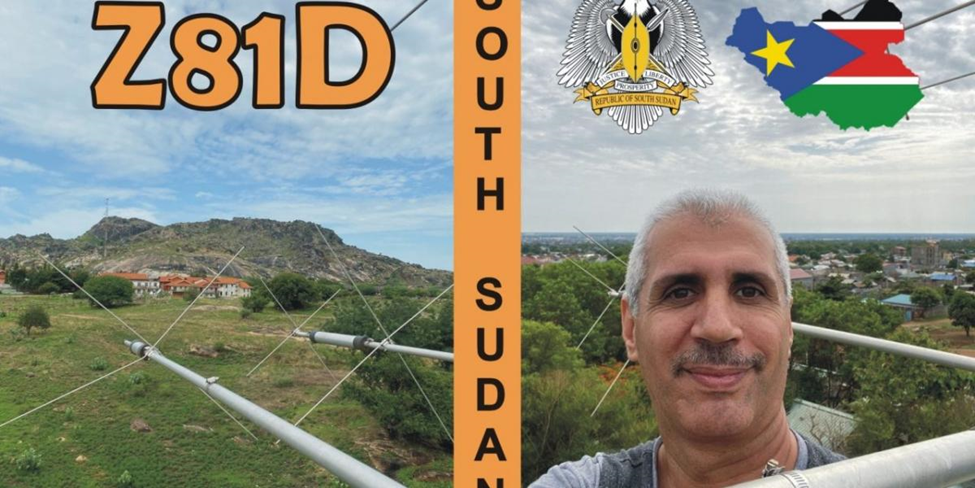
Z81D Diya, YI1DZ will be active from Juba, South Sudan, starting 14 December 2025. He will operate on 40-6m Bands, SSB, FT8 and possibly 80 and 60m. QSL via OM3JW, LOTW, Club Log, eQSL.
Christmas Special Call Signs:
PH25XMAS – from 6th December 2025 until 28th December 2025
PH26HNY – from 28 December 2025 until 5th January 2026
The Radio Scouting Fellowship PA3EFR/J will activate yet again, during the Xmas Season. We celebrate our 5th Anniversary hence the special award for active operators. We work every day in voice and digital modes.
PA25SANTA – 01/12-01/01 2026 Special callsign
PA25XMAS – 01/12-31/12 Special callsign
PD25STAR – 01/12-31/12 Special callsign
PF25XMAS – 01/12-31/12 Special callsign
PI25XMAS – 01/12-31/12 Special callsign
PD26HNY – 01/12-31/01 2026 Special callsign
YO0HOHO, YO0XMAS, YR0UDOLPH – 05/12-31/12 Special callsigns
Christmas in Bethlehem, NM – Dec 19-Dec 24, 1500Z-2359Z, KC5OUR, Peralta, NM. Valencia County ARA. 7.183 14.283 21.283 28.383. QSL. VCARA, P.O. Box 268, Peralta, NM 87042. KC5OUR.com
To find out about any “Call Signs” enter the call sign into the QRZ.Com https://www.qrz.com/ data base which is at the top left under the QRZ Logo on the QRZ site. Note that most Special Stations will allow you to download their certificate by supplying your Event Log.
GL es Gud DX and a very Merry Christmas – Ken VY2RU